The Soviet T-34 is widely regarded as one of the most iconic tanks in military history. Combining firepower, armor, and mobility, it formed the backbone of the Red Army during World War II. Yet, among the thousands produced, one exceptionally rare variant lay hidden for decades at the bottom of the Don River—a wartime relic now standing on display exactly as it was found.
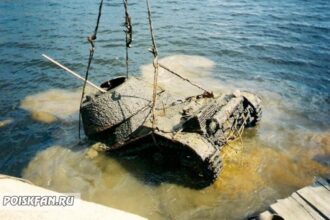
Recovered in 2016 near the village of Ukrainskaya Buylovka in the Voronezh Oblast, this specific T-34 is believed to be the only perfectly preserved survivor of a rare series manufactured by the Stalingrad Tractor Plant (STZ) under frontline emergency conditions.
The Masterpiece of Soviet Armored Warfare
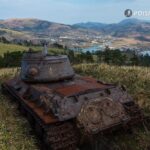
First developed in 1938 by Mikhail Ilyich Koshkin’s design bureau at Kharkiv Plant No. 183, the T-34 was officially adopted into service on December 19, 1939, with mass production launching in 1940.
The success of the T-34 rested on an unbeatable triad of combat performance: formidable firepower, sloped armor protection, and exceptional mobility powered by its highly efficient V-2 diesel engine.
Equipped with a 76 mm main gun, the early T-34 remained the Red Army’s primary medium tank until the upgraded T-34-85 entered service in 1944.
The STZ Legacy: Wartime Economy on the Frontline
Out of the thousands of T-34s built during the war, only an estimated 600 to 1,000 units of this specific configuration were produced at the Stalingrad Tractor Plant (STZ) during the first half of 1942.
Operating dangerously close to the advancing frontlines, STZ was forced to economize materials and simplify production:
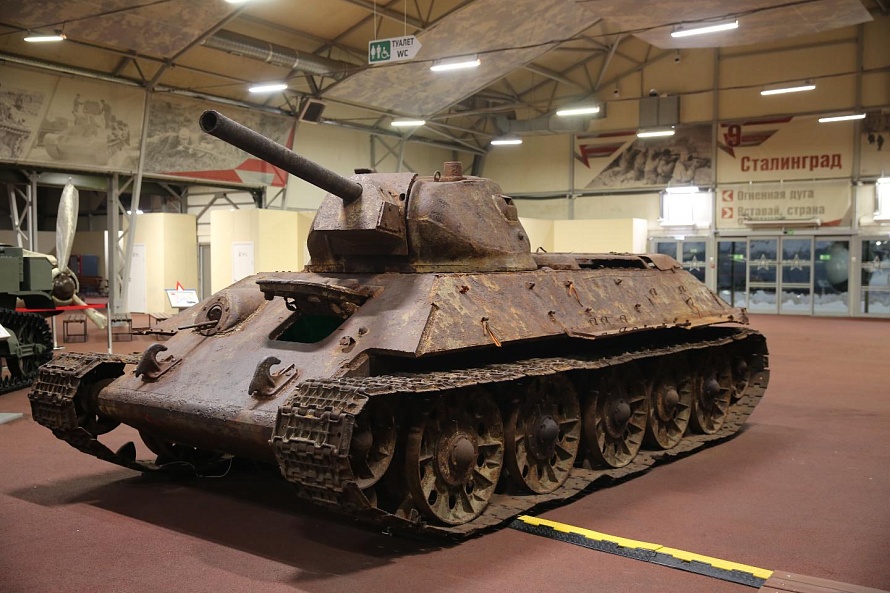
- All-Steel Road Wheels: Due to acute shortages of rubber, the road wheels lacked rubber tires—a signature feature of STZ-built vehicles.
- Wedge-Shaped Gun Mantlet: A distinct, simplified mantlet design set these tanks apart from those built at other Soviet factories.
- Streamlined Components: Internal mechanisms and structural elements were simplified to speed up assembly line output directly into combat.
Lost in 1942: The Battle Damage and River Crossing
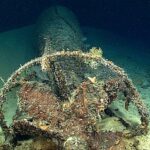
In the summer of 1942, as heavy fighting swept across Southern Russia, this STZ T-34 sank while attempting to cross the Don River.
Close inspection of the recovered hull reveals telltale signs of intense combat:
- Anti-Tank Penetration: A small hole in the second right road wheel was likely caused by a 37 mm projectile fired from a German Pak 35/36 anti-tank gun.
- Surface Shrapnel Damage: Traces of armor-piercing bullets and shell fragments pepper the outer hull and 76 mm gun barrel.
- Miraculous Crew Survival: No human remains were discovered inside the compartment, leading historians to conclude the crew successfully escaped before the tank submersed.
Discovery, Recovery, and Display at Patriot Park
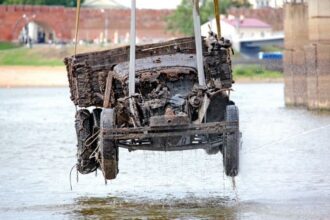
After spending more than 70 years submerged in river mud, the tank was located following tips from local residents. On July 14, 2016, a joint search team from the Russian Ministry of Defense and Patriot Park successfully brought the armored giant ashore.
“According to specialists, the recovered tank is unique because it is the world’s only perfectly preserved example from a small production series that went to the front virtually straight from the assembly line.”
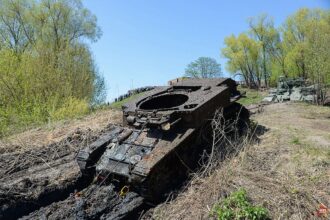
Unlike most museum exhibits, this vehicle has purposely not undergone restoration. It is currently showcased at Museum Complex Site No. 1 at Patriot Park in the exact unrestored state in which it emerged from the Don River—offering visitors an authentic, untouched piece of World War II history.