On June 6, 1944, as over 150,000 Allied troops stormed the beaches of Normandy in the largest amphibious invasion in history, a vastly different drama was unfolding thousands of miles away in South Carolina. For civilians relaxing near Lake Greenwood that afternoon, the horrors of war suddenly felt disturbingly close.
A 20,300-pound North American B-25 Mitchell bomber—piloted by Army Air Service Col. Dan Rossman—clipped the lake’s glass-like surface during a low-altitude flight. The heavy twin-engine aircraft violently slammed into the water, sinking into the murky depths and spawning one of the most intriguing domestic incidents of World War II.
A Deadly Mirror: The Crash at Lake Greenwood
The afternoon weather was deceptively calm, leaving the narrow body of water completely still. For Rossman and his passengers—Lt. Col. John Jackson and Walter “Blackie” Wallace—this stillness posed a fatal hazard.
In an audio diary recorded prior to his passing in 2014, Rossman detailed how the lack of waves made altitude estimation virtually impossible:
“We were coming over the lake, and I remember seeing off to my left a man in a boat, fishing. I think we were eye-to-eye, and if we’re eye-to-eye with each other, that means we’re too low,” Rossman recalled.
Recognizing the imminent danger, Jackson—a seasoned combat veteran who had flown missions across North Africa and Italy alongside Wallace—instantly yanked back on the control stick. The sudden maneuver forced a hard stall, pitching the nose upward just moments before the bomber struck the water.
The impact was brutal. Inside the cabin, Wallace was tossed forward violently.
“I remember feeling something hit my head, and what that something hitting my head is Blackie Wallace going through the airplane… Blackie Wallace has a gash on his cheek, three or four inches long, and I could see his teeth through it,” Rossman described. “He had been lying back on the navigator’s desk behind the cockpit listening to reports about D-Day on the low-frequency radio… How he survived, I don’t know.”
Busting the Local Urban Legend
For decades, the sunken aircraft sparked widespread rumors throughout South Carolina. A persistent myth suggested that the young aviators crashed while buzzing low over the water to get a peek at female sunbathers along the shore.
However, Rossman repeatedly debunked this colorful tale, maintaining that the incident was purely the result of low-altitude flight practice over flat water.
“I’ve said all along that bathing beauties had nothing to do with it, it was straight low flying all along,” Rossman clarified in his accounts.
Ken Berry, President of the South Carolina Historic Aviation Foundation, notes that while the myth added to the plane’s lore, the true story is even more compelling. The B-25, officially designated as “GF2” (and informally dubbed “Skunkie”), served as a vital training aircraft for the legendary Doolittle Raiders—the crew responsible for the historic April 1942 bombing raid on Tokyo.
From Lake Bed to Living History
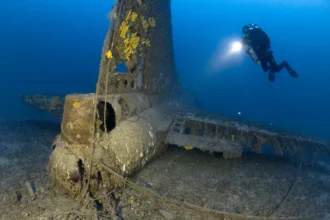
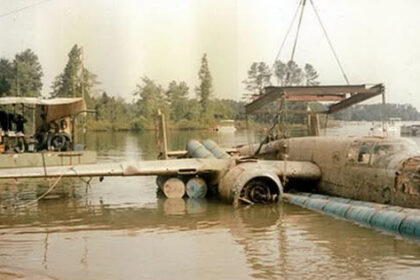
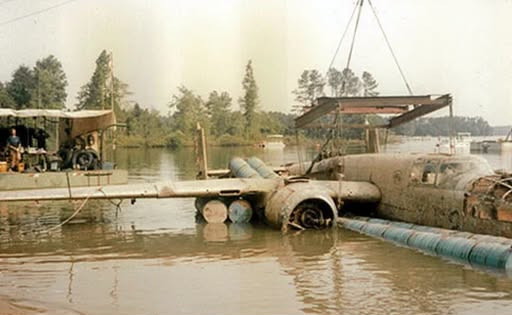
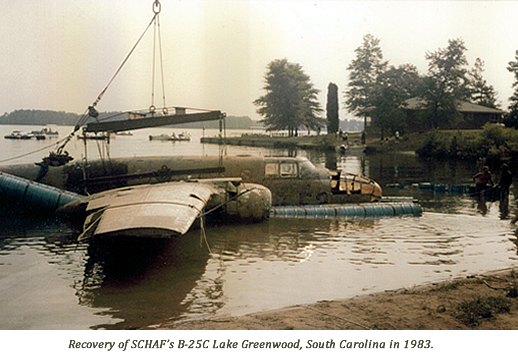
Although early salvage attempts began in the 1960s, the warbird remained under water until 1983. Mat Self—inspired by an article highlighting the National Air and Space Museum’s search for a B-25—spearheaded the recovery mission to pull the aircraft from the lake bed.
Because of the aircraft’s unique connection to South Carolina’s military legacy, local enthusiasts fought hard to keep it in the state:
| Milestone Year | Historical Event / Restoration Progress |
| June 6, 1944 | Aircraft crashes into Lake Greenwood during a D-Day training flight. |
| 1983 | Successfully retrieved from the bottom of Lake Greenwood. |
| 1992 | Cosmetically restored for the 50th Anniversary of the Doolittle Raid reunion. |
| 2002 | Repainted to match the exact markings of Lt. Col. James Doolittle’s aircraft. |
| Present | Under active preservation by the South Carolina Historic Aviation Foundation. |
Preserving a Rare Heritage
Today, dedicated volunteers are working meticulously in Hangar Y-1 at the Jim Hamilton-L.B. Owens Airport in Columbia to return the aircraft to its original 1944 condition. Having completed the cockpit, the restoration team has shifted its focus to the bombardier and navigator stations.
Unlike many surviving warbirds, this B-25 will never take to the skies again—a decision the foundation sees as a protective blessing.
“This B-25 won’t fly again due to being submerged for so long. It would take huge sums of money to rebuild the internal structure to airworthy condition,” explains Ken Berry. “Plus, we think this aircraft, having such a unique local relic quality, is too valuable to be possibly severely damaged.”
Katherine Cuddy, a board member of the foundation, highlights another rare distinction:
“Our plane is the only World War II plane that we know of that has never left the state it was shipped to directly from the factory.”
Coincidentally, another B-25 crashed into nearby Lake Murray a year prior to Rossman’s accident, where its remains still rest today.
Supported by Richland County grants and volunteer dedication, the South Carolina Historic Aviation Foundation continues to prepare “GF2” for public museum display—ensuring that this unique artifact from a historic day lives on for future generations.