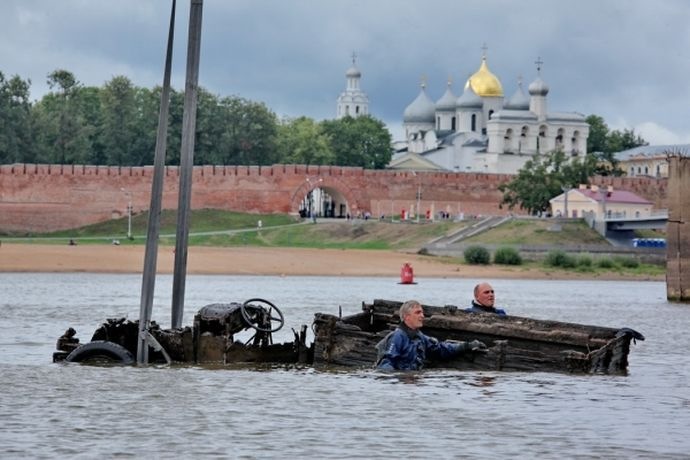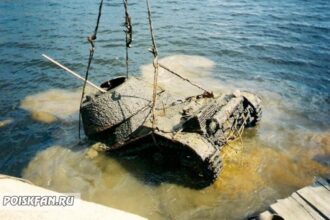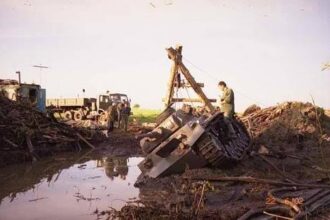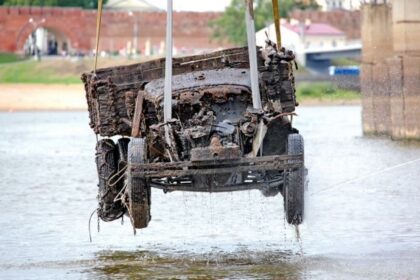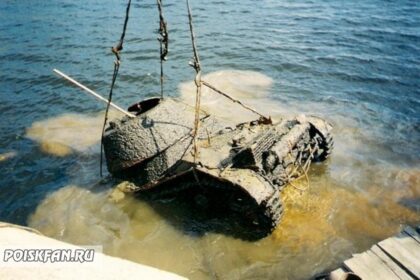
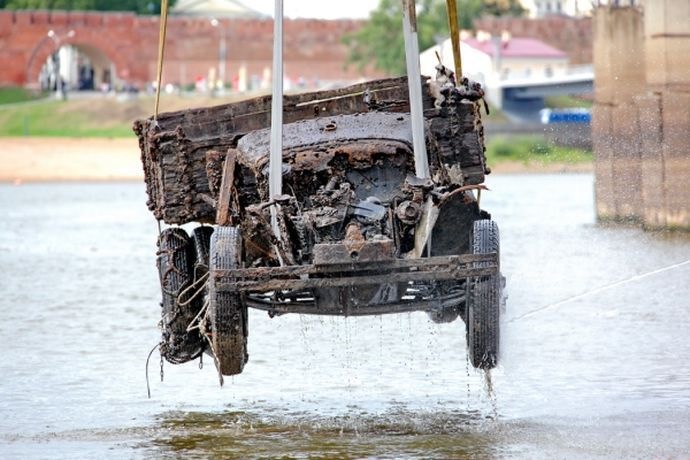
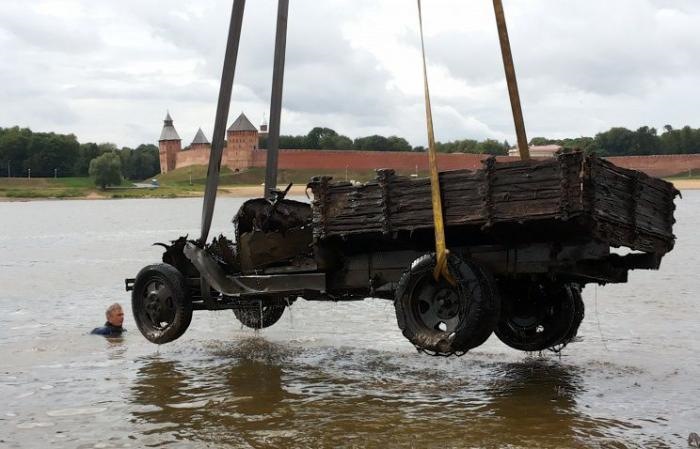
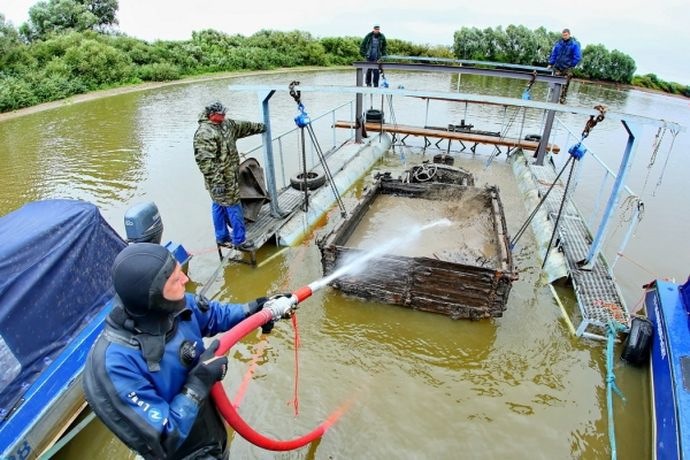
Following a complex three-day salvage operation, underwater specialists successfully raised a historic AMO-2 three-ton truck from a depth of four meters at the bottom of the Msta River.
The vehicle, a vital “workhorse” of the Red Army during World War II, was transported directly to the Novgorod Kremlin, where a dedicated restoration workspace had been prepared. Once fully restored, this iconic vehicle will serve as a central exhibit in a major museum exhibition commemorating the 70th anniversary of Victory in the Great Patriotic War.
The Discovery and Danger: Mortars, Mines, and Mud
The submerged vehicle was first discovered near the confluence of the Msta and Kopka Rivers by an underwater archaeology team led by Alexei Ivanov.
“We identified the vehicle as an AMO-2 and found the driver’s remains inside the cab, still wearing a padded winter jacket. In the cargo bed, there was a 120 mm divisional mortar alongside its full ammunition load,” recalled Ivanov.
Because of the hazardous cargo, regional bomb disposal specialists and divers from the Northwestern Regional Search and Rescue Unit of the Russian Emergencies Ministry (St. Petersburg) were brought in. Before the vehicle could be raised, specialists safely extracted the 120 mm mortar and 34 live mortar rounds from the truck bed.
Uncovering the Crew’s Tragic Final Mission
During the initial site clearance, divers carefully recovered the driver’s remains and handed them over to the “Dolina” (Valley) Regional Search Expedition.
While no personal ID medallion, medals, or named belongings were found in the driver’s pockets, historical evidence indicates the truck sank in early 1944 while attempting to cross the frozen river during the Soviet offensive to liberate Novgorod. Search teams remain optimistic that military loss reports detailing the disappearance of a heavy mortar truck will help identify the fallen soldier.
Furthermore, the final stage of the lift revealed that the driver was likely not alone when the vehicle broke through the ice:
- Multiple Firearms Found: Searchers discovered four individual rifles and submachine guns scattered inside the cab and around the truck, suggesting several soldiers were aboard when the ice collapsed.
Exceptional Preservation: Inflation After 70 Years
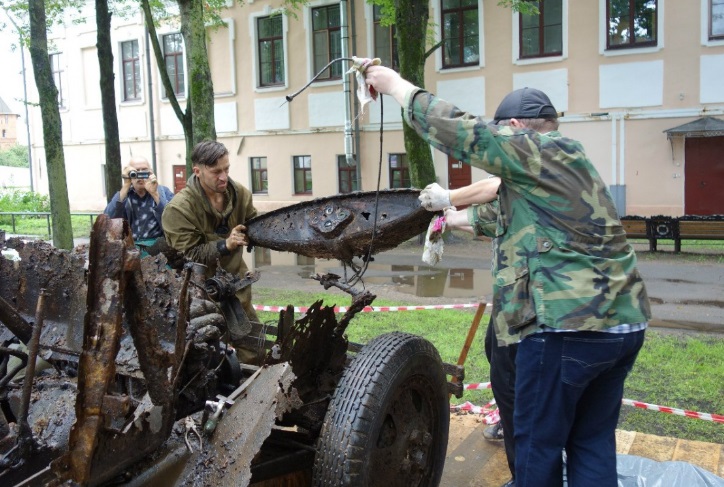
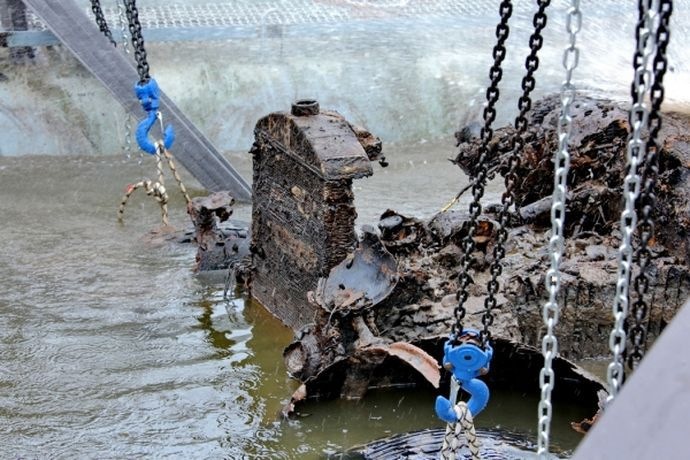
To prevent structural damage to the fragile vehicle, technical teams from Oblvodobyekt constructed a specialized floating pontoon equipped with four heavy winches rather than using a standard floating crane.
Apart from its wooden-and-plywood cab, the truck’s mechanical structure survived in remarkably pristine condition thanks to the anaerobic clay soil of the riverbed.
“The tires look almost new—they are even still inflated. The chassis frame, engine, and gearbox appear completely intact. Most surprisingly, the 1939 Czech-made Varta battery survived with its original electrolyte nearly intact,” shared Mikhail Kondrashev, Director of OGBU ‘Oblvodobyekt’.
A Sealed Mystery Wrapped in 1943 Newspapers
Among the personal artifacts, tools, and weapons recovered from the cabin, one find generated intense intrigue: a dense, elongated package tightly wrapped in Soviet newspapers dated late 1943.
The front page prominently featured the headline “Second Anniversary of the Victory at Tikhvin,” commemorating the critical Soviet counteroffensive of late 1941. Researchers opted not to open the fragile parcel on-site, leaving its contents as an unsolved mystery for Novgorod museum conservators to carefully unravel in the laboratory.