During the high-speed, dynamic battles of World War II, military commanders quickly discovered a major flaw in traditional artillery: towed field guns simply could not keep pace with fast-moving armored columns over rough terrain. Moreover, setting up towed guns took precious time. The solution was as effective as it was practical: mount heavy artillery directly onto reliable tank chassis. Among the most famous of these armored vehicles was the American-built M7 Priest 105mm Self-Propelled Gun.
Development and Design: Built for the Battlefield
Official plans to mount a 105mm howitzer on the chassis of the M3 Lee medium tank began in June 1941. Designers constructed two prototype models, designated the T32, featuring an open-topped superstructure and a modified M1A2 105mm howitzer offset to the right.
Following successful field trials, the design was standardized as the M7 Howitzer Motor Carriage (HMC) in February 1942. Production began two months later at the American Locomotive Company, which built over 2,000 units in 1942 alone.
“The M7 Priest combined standard, highly reliable M3 and M4 medium tank chassis with powerful artillery support. While crew protection was limited by the open-top design, it provided far superior shelter against small arms fire and shrapnel than any towed gun could offer.”
As the M4 Sherman replaced the M3 Lee on assembly lines, production shifted in September 1943 to the M7B1 variant, built on the M4A3 Sherman chassis. Featuring hinged side plates for extra ammunition protection and a one-piece cast nose, the M7 series served as standard equipment in artillery battalions across all American armored divisions until it was superseded by the M37 HMC near the war’s end.
Technical Specifications
- Engine: Continental R-975 C-1 petrol engine (400 hp)
- Top Speed: 24 mph (39 km/h) on-road / 15 mph (24 km/h) off-road
- Armor Thickness: 12 mm to 62 mm
- Primary Weapon: 105 mm Howitzer (Maximum range: 7 miles / 11.27 km)
- Secondary Weapon: .50 caliber (12.7mm) M2 Browning machine gun mounted in a defensive pulpit
- Ammunition Capacity: 69 shells (primarily High Explosive HE, supplemented by smoke and armor-piercing AP rounds)
The M7 Priest in British Army Service
The British Tank Mission spotted the early T32 prototype in March 1942 and immediately requested thousands of units. Though initial orders were delayed to prioritize American forces, a critical situation for the British 8th Army in North Africa prompted the immediate delivery of 90 M7s in September 1942.
Officially designated by the British as the 105mm SP, Priest, the vehicle earned its famous nickname from the armored, pulpit-like machine gun tower on its superstructure—continuing a British tradition of naming self-propelled guns after religious figures (such as the Bishop and Deacon).
The M7 Priest played a crucial role in the Battle of El Alamein and served throughout the Italian Campaign. British and Canadian forces also fielded Priests during the Normandy landings on Gold, Juno, and Sword Beaches, while US forces relied on them at Utah and Omaha Beaches.
“By August 1944, most British M7 Priests were phased out in favor of the 25-pounder Sexton self-propelled gun. This shift was primarily made to standardize ammunition within the 21st Army Group and free up vital 105mm shell supplies for American forces.”
From ‘Defrocked Priests’ to ‘Kangaroos’
Rather than handing surplus M7s over to American troops, the British Army ingeniously repurposed them. Workers removed the main 105mm guns and welded extra armor plating over the open front shields, converting the chassis into heavy armored personnel carriers.
Initially dubbed “defrocked Priests,” they quickly became known to troops as “Kangaroos.” These converted vehicles played a pivotal role in troop mobility during the armored breakout from Caen in Operation Totalize.
The Normandy Wreck at Musée des Épaves Sous-Marines
For history enthusiasts visiting the Normandy landing sites, a remarkable piece of M7 history lies on display at the Musée des Épaves Sous-Marines du Débarquement (D-Day Underwater Wrecks Museum).
Located along the D6 road from Bayeux to the coastal village of Port-en-Bessin-Huppain, the museum grounds are marked by a tall wall of evergreen trees, a crane, and three flags: the French Tricolour, the British Union Jack, and the American Stars and Stripes.
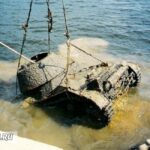
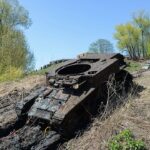
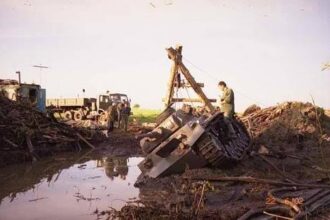
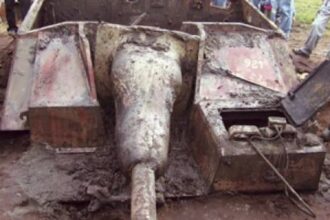
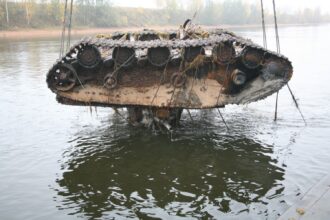
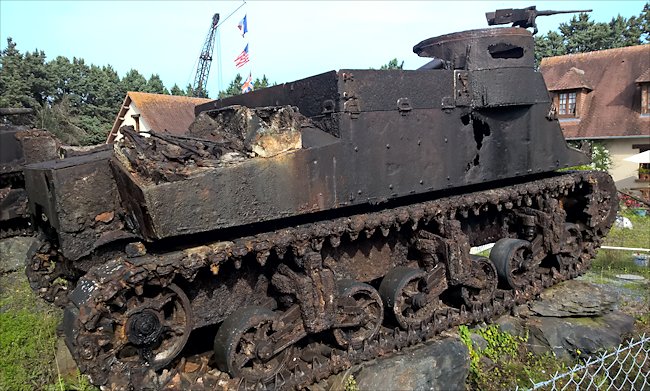
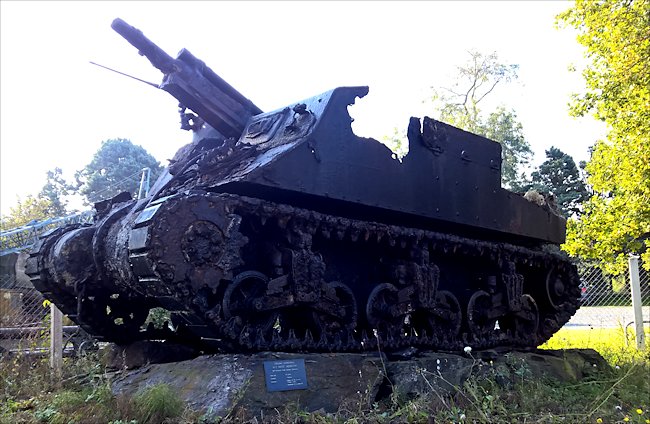
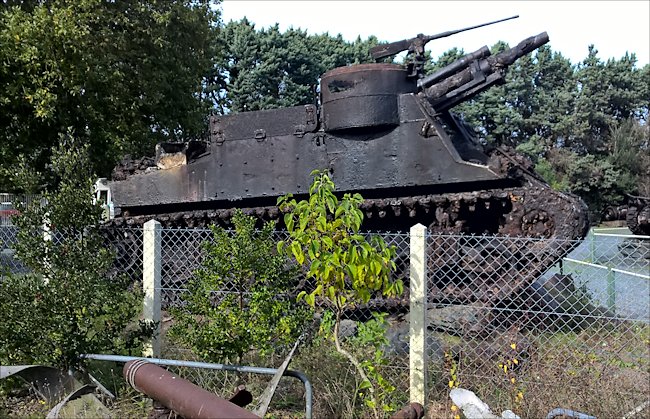
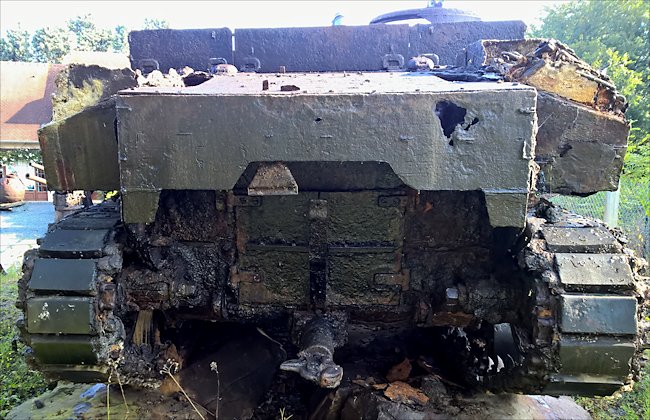
Among the museum’s fascinating displays is a salvaged M7 Priest recovered from a submerged Landing Craft Tank (LCT) that sank 3 miles off the coast of Omaha Beach.
Excerpt from the Museum Memorial Plaque:
“M7 Priest Howitzer from the 58th Armored Field Artillery Battalion, recovered from a landing craft LCT wrecked 3 miles from Omaha Beach carrying two jeeps, three half-tracks, and four M7 Priests. Inside the vehicle were found documents that enabled the identification of the driver John H. Glass and the reconstruction of its incredible journey from North Africa to the Normandy Landings.”