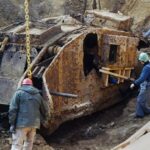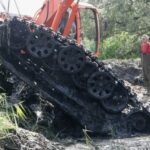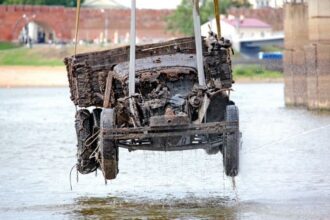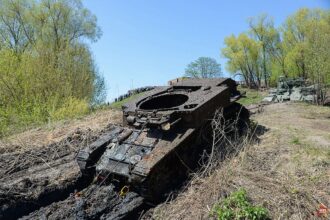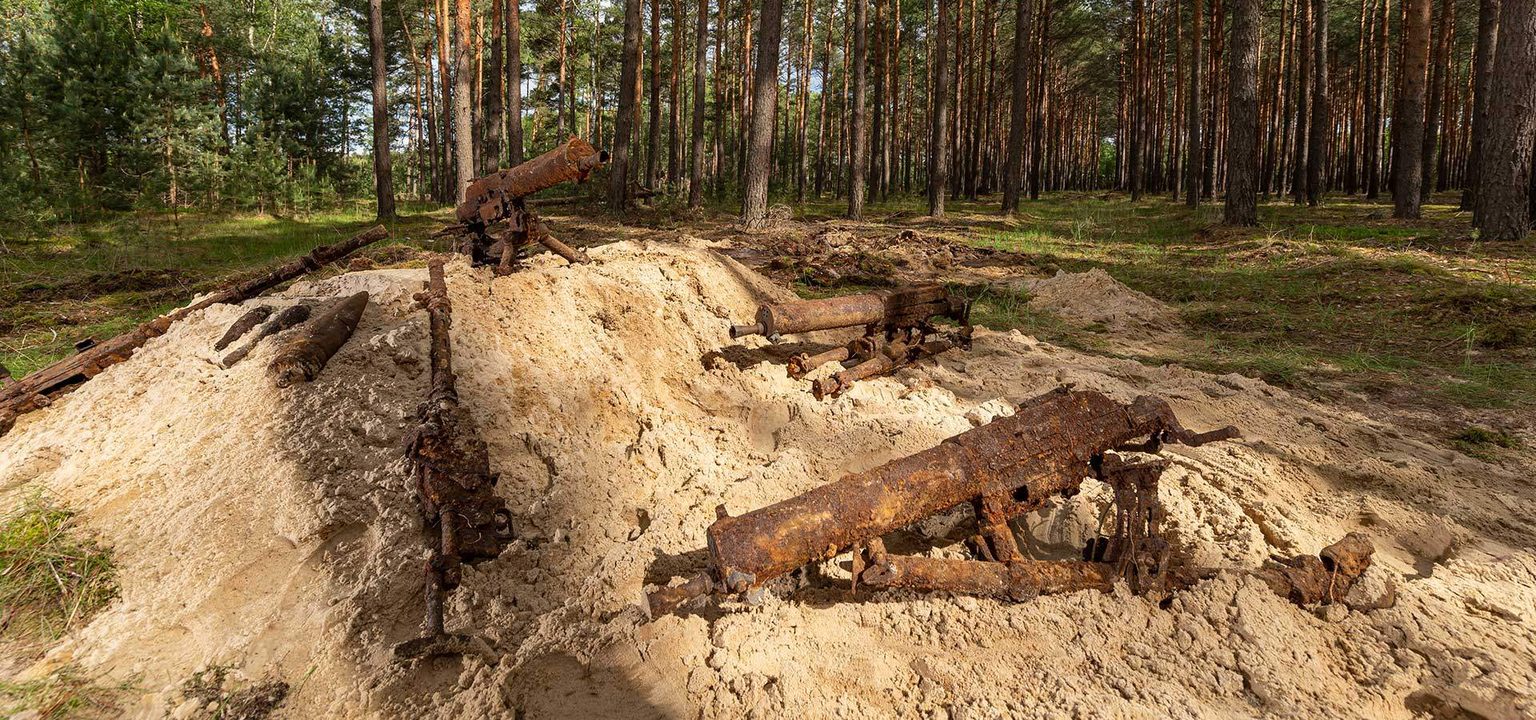
Just a few centimeters beneath an unremarkable patch of coniferous forest in eastern Germany lay a dramatic, hidden chapter of World War II history. Discovered in the Oderbruch (Freienwalder Lowlands) along the Oder River, near the Polish border, a remarkable weapons cache offers a fascinating window into the desperate final weeks of the Second World War.
The site contained an extraordinary mix of small arms, heavy artillery shells, and rare modified infantry weapons that tell a compelling story of conflict and field adaptation.
A Desperate Last Stand: The Volkssturm Connection
Although buried during World War II, much of the discovered weaponry and ammunition originally dated back to World War I.
The unusual mix of outdated armaments, along with improvised battlefield modifications, strongly indicates that this equipment belonged to the Volkssturm—the national militia created in late 1944 as Nazi Germany faced total collapse.
“Armed with whatever surplus weapons remained in storage, the poorly equipped Volkssturm had relatively low combat value and was primarily assigned auxiliary duties in support of the Wehrmacht.”
The Star Find: Austro-Hungarian Schwarzlose M.7/12 Heavy Machine Guns
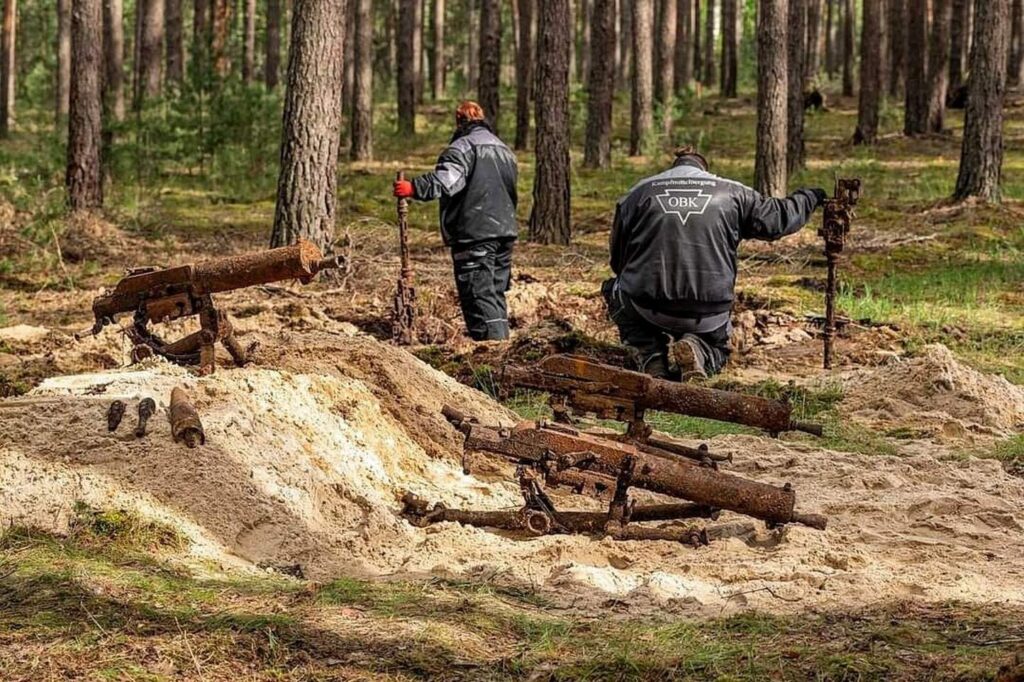
Among the most significant weapons unearthed at the site were three Schwarzlose Modell 1907/12 heavy machine guns (designated in Poland as the wz. 07/12).
This heavy firearm carries a rich military legacy:
- Austro-Hungarian Legacy: Designed by Andreas Wilhelm Schwarzlose at the turn of the 20th century and mass-produced under license by OEWG (later Steyr), it was the primary heavy machine gun of the Austro-Hungarian Army during WWI.
- Unique Blowback Mechanism: Schwarzlose patented an innovative fixed-barrel, semi-blowback mechanism using two hinged levers to delay the opening of the breech block.
- Engineering Solutions: To stop cartridge cases from rupturing during extraction, an automatic oiler lubricated each round before firing. The barrel was shortened to just 530 mm to lower gas pressure rapidly, giving it one of the shortest barrels of any machine gun of its era.
- Dual-Use Weapon: Beyond ground warfare, the Austro-Hungarian aviation service also deployed the Schwarzlose as aircraft armament.
Field Improvised: The Norwegian Madsen M1903
Alongside small-arms ammunition and artillery shells, researchers identified another rare gem: a Danish Madsen M1903 light machine gun firing 6.5–8 mm rounds.
This specific weapon was widely used by the Norwegian Army, but this excavated example featured a fascinating battlefield modification:
- Design & Origin: Originally created by Jens Schuboe and refined by Danish officer Wilhelm Madsen, it was mass-produced starting in 1902–1903 by Dansk Rekylriffel Syndikat A/S in Copenhagen.
- Volkssturm Modification: The excavated firearm appears to be a rare anti-aircraft variant improvised for field use by adapting it to fit a German MG34 bipod—a textbook example of how militia forces combined mismatched military gear.
Echoes of the Battle of the Seelow Heights
Historians believe this weapons cache is directly connected to the brutal Battle of the Seelow Heights, fought between April 16 and May 2, 1945. As part of the Soviet Berlin Offensive, this battle represented one of the last major assaults against German defensive lines in Europe.
The Scale of the Engagement
- The Soviet Force: Nearly 1,000,000 Soviet soldiers from the 1st Belorussian Front under Marshal Georgy Zhukov struck the defensive line known as the “Gateway to Berlin.” This force included 78,550 Polish soldiers serving in the 1st Polish Army.
- The German Defense: Approximately 91,000 German soldiers of the 9th Army (part of Army Group Vistula), commanded by Theodor Busse, attempted to hold off the advance.
Today, this quiet woodland along the German-Polish border no longer echoes with artillery fire. Yet, buried just beneath the pine needles, these preserved iron relics serve as a tangible reminder of the chaotic climax of World War II.