Imagine a massive First World War tank, buried and forgotten beneath the French soil for nearly a century. This isn’t the plot of a Hollywood movie – it’s the remarkable true story of Tank D51, famously known as ‘Deborah’.
Discovered at Flesquières near Cambrai, Deborah’s history is a poignant tale of early armored warfare, devastating tragedy, and one local man’s relentless quest to uncover a lost piece of world history.
A Trial by Fire at Ypres
Before her fateful deployment at the Battle of Cambrai, ‘Deborah’ saw brutal action at Ypres. On August 22, 1917, she was waiting to engage the enemy in the Poelcapelle area under the command of 2/Lt George Ranald Macdonald.
Suddenly, tragedy struck. An enemy shell scored a direct hit on the tank’s track.
“When hit, ‘Deborah’s’ crew did not come through unscathed.”
The impact of the shell was devastating:
- 2/Lt Macdonald was severely wounded and taken out of action.
- L/Cpl David Marsden and Private Walter Robinson sustained injuries, but incredibly, remained on duty.
Deborah was swiftly replaced for that action and sent away for extensive repairs. Her resilient crew, meanwhile, was transferred to France, waiting to reunite with their machine for the upcoming offensive.
The Road to Cambrai: A Tragic Timeline
Once repaired, Deborah rejoined ‘D’ Battalion at the Wailly Base Camp. The weeks leading up to her final battle were a flurry of preparation.
Here is how Deborah’s final days in action unfolded:
- November 6: The crew conducted tactical training alongside the famed 51st (Highland) Division.
- November 12–13: The Battalion entrained at Beaumetz-les-Loges, arriving at Plateau station before driving to the southern edge of Havrincourt Wood to prepare for battle.
- November 20: Under the new command of 2/Lt Heap, Deborah rolled into the Battle of Cambrai.
The attack on November 20 proved to be a dark day. L/Cpl Marsden was injured yet again. Tragically, Private Robinson and four other crew members lost their lives. Deborah herself was catastrophically damaged—ultimately buried, left behind, and forgotten.
The 1990s Discovery: Following a “Treasure Map”
For decades, Deborah was completely out of sight and out of mind.
But in the early 1990s, Philippe Gorczynski, a local hotel owner and Great War enthusiast, heard a local rumor. An elderly resident remembered a tank that might have been buried somewhere in the area. Intrigued, Gorczynski took up the search.
“It’s as if I had been given a treasure map. To begin with, the account turned out to be very interesting, but then on the ground, it turned out to be a lot more hazy because I couldn’t see a thing.” – Philippe Gorczynski
Gorczynski persevered. Though he had already unearthed nearly three tonnes of scattered tank parts in the region, his goal wasn’t to assemble a giant puzzle. “I had to find it at any cost,” he noted. “I wanted to find a whole one.”
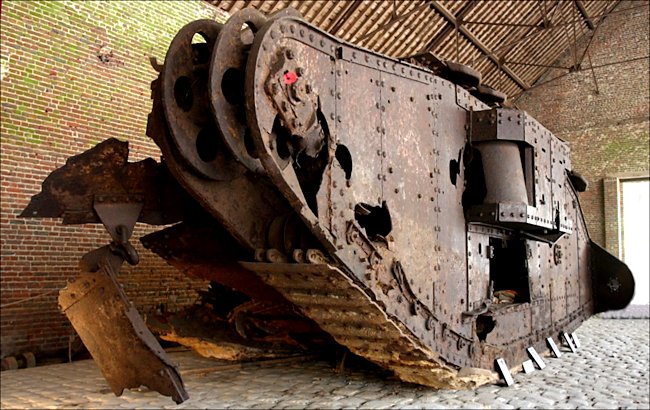
Seeing the Light of Day
After years of poring over aerial photographs and hundreds of archival documents, Gorczynski’s hypothesis was finally put to the test.
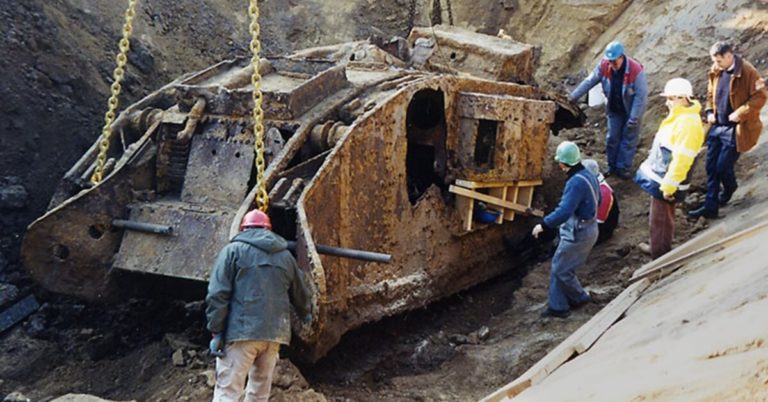
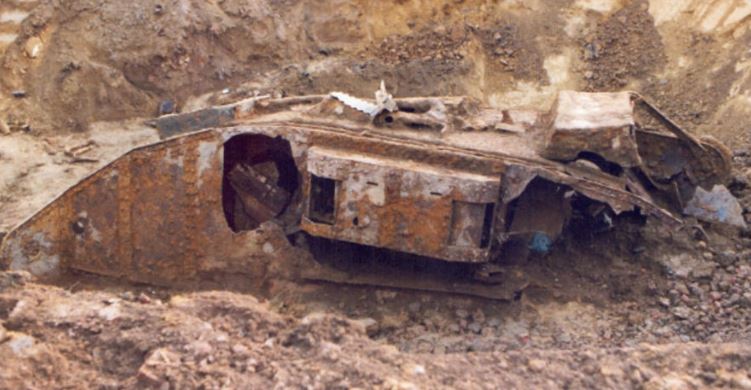
In November 1998, a ground survey at the presumed resting place proved him right. Just two weeks later, with the help of the Arras Archaeology Service, Deborah was carefully excavated, seeing the light of day for the first time in over 80 years.
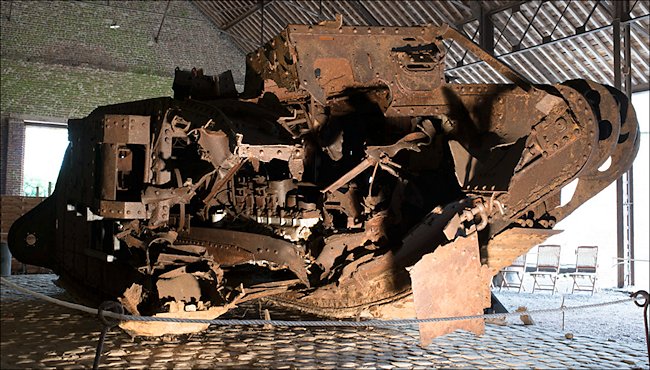
A Fitting Final Rest
Today, Deborah is no longer a forgotten relic of the trenches:
- Historical Monument: She was officially registered as a Historical French Monument on September 14, 1999.
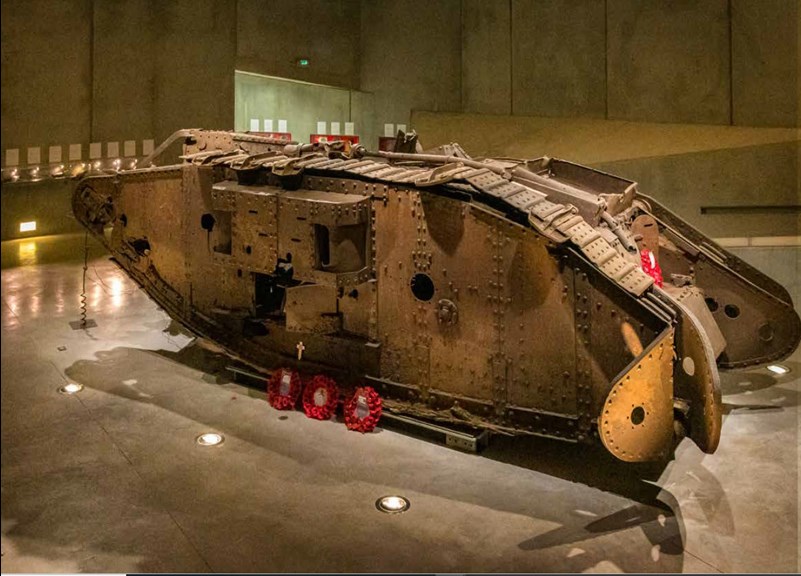
- A New Home: After spending years sheltered in an open barn, a purpose-built museum was inaugurated in 2017 to preserve her from the elements.
Fittingly, this modern structure stands right next to the Flesquières Hill British Cemetery-the final resting place of five of the brave men who fought and died inside her.